Update (November 3): The reveal has happened — and the H3C is real, and on sale. Bambu Lab launched the H3C on November 3 at 9:00 AM EST, built around Swaptek, a nine-tool changer: nine PrintTools, each with its own heater, cutter and filament path, staying loaded and pre-heated so a material switch takes 6 seconds (3.4 seconds for the tool change itself, 0.038 g of purge in Bambu’s internal tests). The H3C AMS Combo, which includes the AMS 3H, is US $2,499 (excluding tax, including shipping; €2,499 including tax in the EU), available from November 3 at Bambu Lab’s official store, with US orders shipping within 1 to 3 business days once processed. Build volume is 330 × 320 × 325 mm, top speed 1,400 mm/s at 25,000 mm/s² acceleration, nozzles to 350°C, and an actively heated chamber to 65°C. The teasers check out: every nozzle from 0.2 to 0.8 mm is HRC 55+ hardened steel, and Bambu’s mixed-nozzle example is a watch printed in one job — 0.2 mm for the dial details, 0.4 mm for the case, and a 0.4 mm nozzle on 2.85 mm filament for the soft TPU strap, with TPU as soft as 75A via the FlexFeed extruder. One correction to the speculation above: the patent described ten nozzles (nine parked plus one on the toolhead); the shipping H3C has nine PrintTools, and Bambu has not said it uses the patented 10-nozzle system. P3C, X2D Pro and AMS 3P remain unannounced.
Update (October 29): This story has moved faster than the Formnext timetable suggested. On October 23, Bambu Lab officially teased the H3C, a “next-generation tool changer” with nine tools in one printer, and set the reveal for Tuesday, November 3 at 9:00 AM EST. At that point, no price or specifications had been published yet and Bambu has not said the H3C uses the patented 10-nozzle system described below — the nine-tool count is suggestive, not a confirmation. P3C, X2D Pro, AMS 3H and AMS 3P are still unannounced. The practical effect is simple: the wait for real H3C facts is now days, not weeks. If your purchase can wait until November 3, you will be deciding on Bambu’s numbers, not on filings.
One more teaser today, Oct 30: Bambu posted “[Bambu Lab H3C] HRC 55+. All of them” — “Durable by design. Hardened by default.” Bambu has not said which parts the HRC 55+ figure applies to, and the H3C’s own price, build volume and shipping date are still unknown.
Bambu Lab has since announced a new printer — see the November 3 update above. But its latest patent filings show where its engineers are spending their time — and it’s a bigger swing at multi-color printing than anything on sale today.
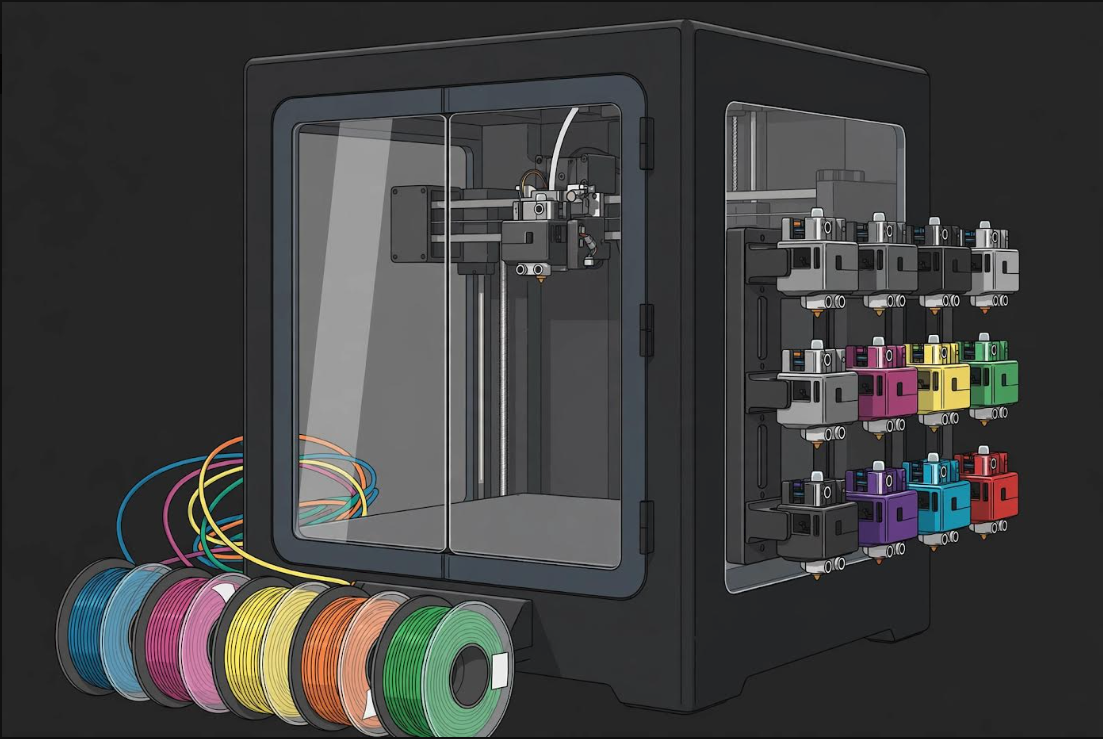
On August 14, China’s patent office published three invention patent applications from Bambu Lab (publication numbers CN 122560409 A, CN 122560412 A, and CN 122560413 A). Together they describe a printer with ten nozzles: nine interchangeable printheads parked in a storage rack, plus one riding on the toolhead, fed by ten filament spools.
Before the speculation runs away, the important context: a patent is not a product. These documents describe mechanisms, not a launch. Bambu Lab has not announced a printer — but the “H3C” name is no longer just forum speculation: a US FCC equipment filing dated September 11, 2026 (FCC ID 2A6J8-PF008P) describes an “H3C 3D Printer,” and related filings cover a “P3C” (September 15), an “X2D Pro,” and two new material systems, the AMS 3H and AMS 3P (September 21, models SA017 and SA018). One breakdown of the filings notes the H3C and AMS 3H test reports place both devices in the same tested setup — suggestive, not proof of compatibility; the filings themselves establish no link between the printer and the material systems. An FCC filing confirms a device went through certification — it reveals no specs, pricing, or launch date. Companies also patent engineering they never ship. What the patents tell you is what Bambu protected and when, not what you’ll be able to buy or when.
The filings-as-early-warning method just proved itself: on October 12, Bambu officially teased the S1 3D scanner — first spotted in this same batch of FCC records — for a November 2026 launch. That’s roughly three weeks from regulatory paperwork to a launch month. The H3C, P3C, and X2D Pro are still unannounced, but the S1 shows these filings are worth watching rather than dismissing.
What the filings actually show
Ten nozzles, densely packed. The rack holds nine swappable printheads, and the drawings show the dock spacing is tighter than one toolhead-width per slot — the patent specifically claims adjacent docks sit closer together than the toolhead’s own width. For comparison, the shipping H2C’s Vortek system carries six swappable hotends plus one fixed nozzle. This is a meaningfully bigger magazine.
Faster swaps, by design. One filing covers a mechanism where unlocking a printhead and setting it into the rack happen in a single motion instead of two — one fewer step per swap, and no moment where a printhead floats loose between “unlocked” and “seated.” Another details how three locating members lock a parked printhead along all three axes so swaps stay repeatable.
Vision hardware keeps getting smarter. The toolhead filing routes lighting through the part-cooling duct itself, aimed at the nozzle, with a split black-and-white interior surface to keep the nozzle brightly lit without blowing out the camera’s exposure. It’s aimed squarely at the AI vision features Bambu markets — spaghetti detection, blob detection, foreign-object checks. None of Bambu’s current machines light the nozzle this way.
The timeline is the tell
Two of the three filings claim priority back to November 2025 — days before the H2C went on sale. That’s textbook practice: file first, disclose second, so the patent coverage is in place before the product it’s protecting reaches customers. The third filing (the toolhead) claims no priority at all, making it the genuinely new work — and the strongest hint of where the next platform is headed.
One more signal: these went from filing to publication in about six weeks, versus the usual ~18 months. That only happens when the applicant requests early publication — something a company does when it wants the public record, with a date on it, to show the ground is already taken.
Should you wait to buy?
Probably not — but keep one eye open. Nothing in these filings is a launch date, and waiting on a machine that may never ship is how you lose months of printing. If you’re shopping for multi-color today, buy what’s in stock and proven — the H2C’s hotend-swapping system is real, shipping, and reviewed.
The one thing that changed the calculus: the FCC filings mean Bambu has hardware far enough along to certify, so announcements could come with little warning. One watch date: Formnext runs November 17–20 in Frankfurt — a major industry stage that could serve as a reveal window, though Bambu hasn’t connected the H3C to it. If your purchase can wait a few weeks without costing you, watching for an announcement is reasonable. If you need to print now, buy now.
Mid-article CTA: Shopping for multi-color right now? Browse our Bambu Lab printers in the store — including the X2D.
The broader trend is still worth watching, though. Every major brand is attacking the same problem — wasted filament and slow swaps in multi-color printing — from a different angle, and nobody has converged on one answer yet. We’ll keep covering the developments that actually matter for buyers.
End CTA: Want multi-color without the wait? See the Bambu Lab X2D in our store.



2 thoughts on “Bambu Lab’s 10-Nozzle Patent: What It Actually Shows”