For the past three years, desktop multi-color 3D printing was defined by a single architecture: the external filament multiplexer. The tool changer 3D printer changed that. Pioneered for the mainstream by Bambu Lab’s original AMS and quickly followed by Creality’s CFS and Anycubic’s ACE Pro, single-nozzle filament switchers unlocked four-to-sixteen-color prints for everyday makers.
They also created an infamous new problem: the “poop chute” and the 40-hour print.
Every time a single-nozzle multiplexer switches materials or colors, it has to cut the active filament, retract it out of the tool head, push the new filament in, and purge the molten transition zone until the old color or material is completely flushed. On complex multi-color models, purge waste routinely exceeds the weight of the actual part, and cross-material printing—like pairing rigid PETG or PLA with soft TPU or dedicated breakaway support—often risks nozzle clogs or weak layer adhesion from residual polymer contamination.
In late 2026, the industry’s center of gravity has decisively shifted. Physical tool changers and multi-nozzle swappers have moved down from $4,000+ enthusiast rigs into factory-built consumer and prosumer flagships. Today, buyers looking at multi-material printing face a fascinating three-tier showdown:
- The Ultimate Prosumer Tool Changer: Bambu Lab’s H3C (9 independent
SwapTektools +AMS 3H) — closest Bambu we stock: the X2D - The Mainstream Multi-Nozzle Disruptor: Creality’s K3 (4-nozzle
KliTekquick-swap CoreXY) — closest multi-colour Creality we stock: the K2 Pro Combo - The Refined Multi-Spool Value Kings: Anycubic’s Kobra 4 (
ACE 2 Pro) and Kobra 3 V2 (ACE Pro)
Here is how these three philosophies—and four machines—stack up at the end of 2026.
Prices below are typical US street prices.

1. Bambu Lab H3C: The 9-Tool Industrial Juggernaut
After experimenting with dual-nozzle and induction nozzle-swapping architectures in its earlier H2 series, Bambu Lab went all-in with the H3C. Priced around $2,499 with the bundled AMS 3H, the H3C is not trying to be a budget printer—it is a full-blown desktop manufacturing cell designed to make single-nozzle purging obsolete for serious creators and engineers.
How SwapTek™ Works
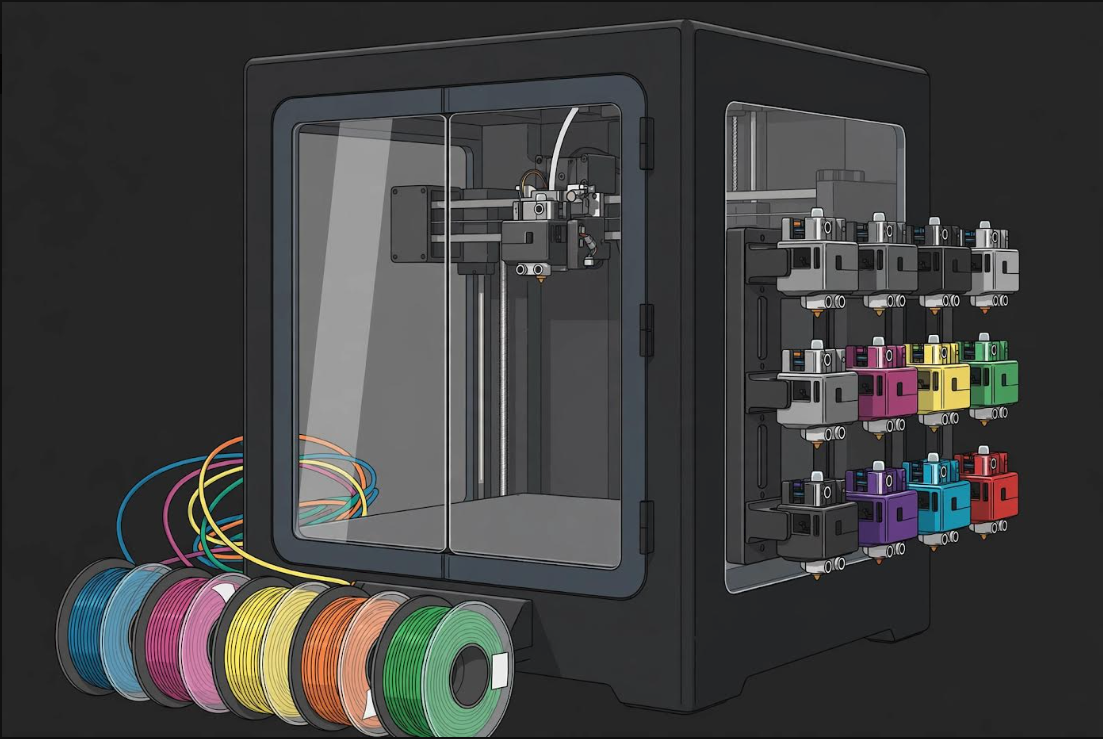
Instead of retracting filament yards back into a spool box, the H3C stores 9 independent Print Tools along a retractable rack inside the front of the build chamber. Each Print Tool stays preloaded with its own filament path and heater assembly. When a tool change is called:
- The carriage docks the current
Print Tooland grabs the next preheated tool in under 6 seconds. - Because each tool holds its own melt zone, there is no color flushing required—just a microscopic 0.038 g prime to stabilize nozzle pressure.
Why 9 Tools Change the Game
Having nine physical tools unlocks workflows that single-nozzle hubs simply cannot touch:
- Mixed-Nozzle Printing: You can load a 0.2 mm nozzle for razor-sharp text and miniature facial details, a 0.4 mm nozzle for standard perimeters, and an 0.8 mm nozzle to lay down structural infill at blistering speeds—all within the same print job and without forcing uniform layer heights.
- True Multi-Durometer & Engineering Blending: Paired with the AMS 3H (which seals 9 spools and includes an 85°C two-slot active dryer for hygroscopic nylons and poly carbonates) and a 65°C actively heated chamber, the H3C’s
Flex Feedsystem handles both 1.75 mm and 2.85 mm filaments. It can print ultra-soft 75A TPU directly onto rigid PC, PA-CF, or ABS frames without jamming. - Beyond Extrusion (
Craft Tools): Because the carriage is a true tool changer, Bambu opened the dock to non-printing heads, including blade-cutting, pen-plotting, foil-transfer, and de-bossing attachments.
2. Creality K3: Bringing 4-Nozzle Changing Under $1,000
If the Bambu H3C proves what is possible at $2,500, the Creality K3 is arguably the most disruptive machine of late 2026 because of its price tag: $849.
For less than the cost of many last-generation single-nozzle CoreXY combos, Creality engineered a 260 × 260 × 260 mm enclosed CoreXY machine built around KliTek™, a proprietary 4-nozzle quick-swap system.
How KliTek™ Bridges the Gap
Rather than carrying nine heavy full-extruder toolheads, the K3 keeps four dedicated filament channels routed to the top of the motion system and physically swaps lightweight, independent hardened-steel nozzle assemblies using a high-reliability USB-C quick-swap coupling monitored by 12 dedicated alignment and locking sensors (part of a 37-sensor array across the printer).
- Sub-5-Second Swaps: Switching from nozzle 1 to nozzle 4 takes 4.8 to 5 seconds. Creality estimates this cuts total multi-color print times by up to 80% and slashes filament waste by 85% compared to traditional single-nozzle purge towers.
- Mixed Orifices & CMYK Blending: Like the H3C, the K3 allows mixing 0.2 mm, 0.4 mm, 0.6 mm, and 0.8 mm nozzles in the same job—letting you pair a 0.4 mm outer wall with an 0.8 mm high-flow infill to cut print times by another 30%. The K3 ships with four 0.4 mm nozzles only, so mixing sizes means buying extra nozzle assemblies separately — and 0.2 mm and 0.8 mm can’t be used together in the same print. For aesthetic prints, loading translucent Cyan, Magenta, Yellow, and White/Black into the four dedicated nozzles enables physical CMYK color layering without cross-contamination.
- Flexible Filaments Solved — With a Caveat: Multi-color hubs famously choke on TPU. Out of the box, the K3 prints TPU 95A alongside PLA, PETG, or ABS. Softer 85A–95A TPU needs the optional TPU Kit (dry boxes, CFS FLX feed unit and the S-Drive™ extruder) — Creality hasn’t announced a price or date for it yet, and Tom’s Hardware found it unavailable at launch.
The Trade-off
Four nozzles is the sweet spot for functional multi-material printing (e.g., Primary Material + Secondary Material + TPU Seal + Dedicated Support Material) and 4-color models. However, if you routinely print 6-to-8-color character figurines with distinct opaque hues, four physical nozzles hit a hard ceiling unless you rely on CMYK translucent blending.
First independent review: Tom’s Hardware (Nov 2) found the KliTek changer reliable — no dropped tools, no bad prints — but flagged the missing lid and TPU kit at launch, loud operation, and spool holders too large for many third-party spools.
3. Anycubic’s ACE Multi-Spool Ecosystem: Kobra 4 & Kobra 3 V2
With Bambu and Creality racing toward mechanical tool and nozzle changers, is the single-nozzle multi-spool hub dead? Not when you look at the price tag.
Anycubic’s Kobra 4 (paired with the new ACE 2 Pro) and Kobra 3 V2 (paired with the ACE Pro) prove why multi-spool multiplexer boxes remain the undisputed kings of entry-level and sub-$500 multi-color printing.
How the ACE Approach Differs
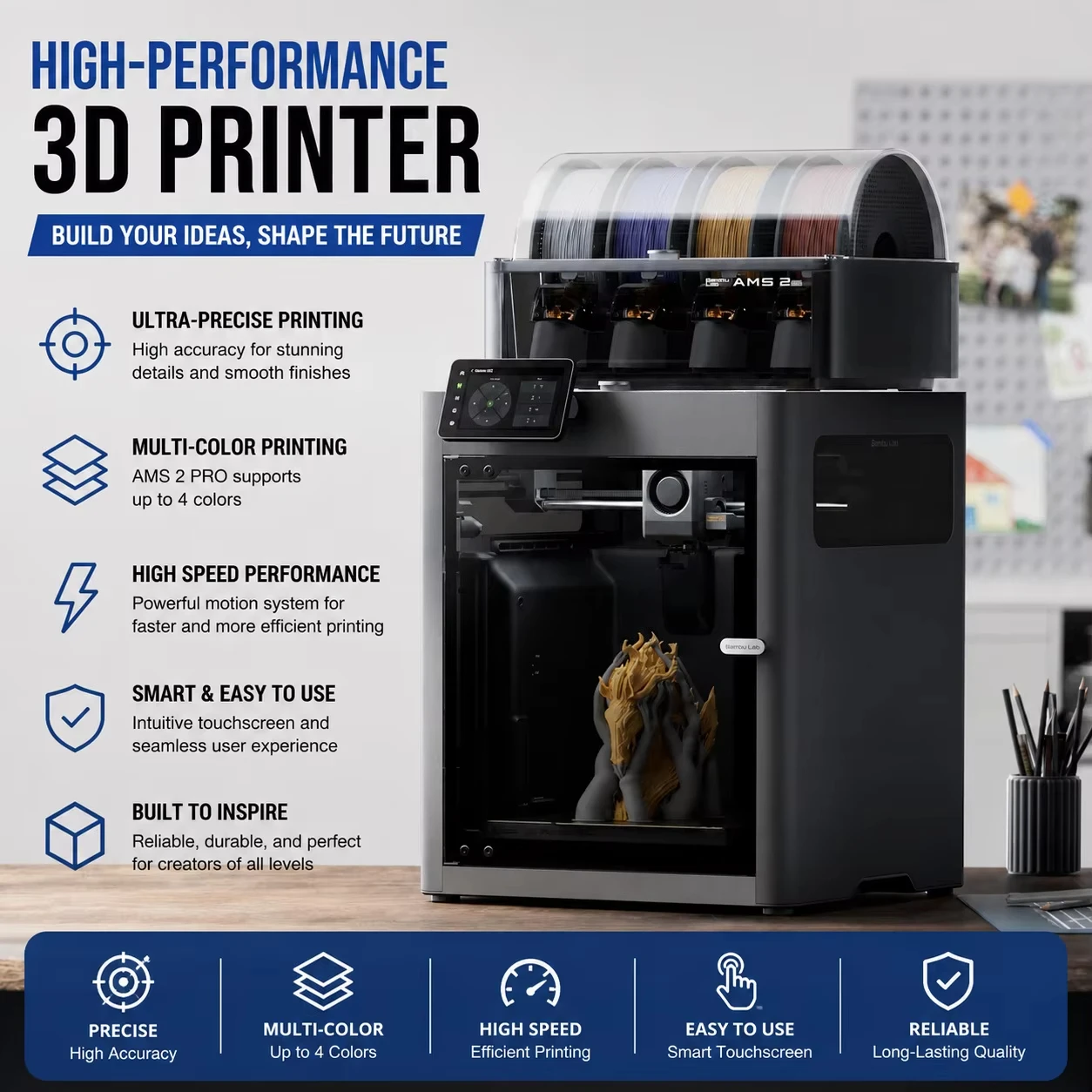
Neither the Kobra 4 nor the Kobra 3 V2 swaps nozzles during a print. Instead, their external ACE (Anycubic Color Engine) boxes hold 4 spools (expandable to 8 spools by daisy-chaining two units) and feed them through a 4-to-1 buffer into a single 300°C quick-release hot end on an open-frame bed slinger.
While that means you still pay the “purge tax” in filament poop and 45-to-90-second swap times, Anycubic has refined this architecture to solve the biggest headaches of budget multi-color printing:
- Built-In Active Drying While Printing: The standout feature of the ACE ecosystem is that the spool box is a heated filament dryer. The ACE 2 Pro on the Kobra 4 boosts active drying up to 65°C, keeping moisture-sensitive PETG and PLA bone-dry mid-print without buying a separate dryer.
- Kobra 3 V2 vs. Kobra 4 Refinements:
- The Kobra 3 V2 (255 × 255 × 260 mm, ~$425–$495 Combo) addressed early Kobra 3 feedback with a wider, stiffer Y-axis rail, improved
LeviQ 3.0auto-leveling, motor anti-skip recovery, and a 110°C bed. - The Kobra 4 (260 × 260 × 260 mm, ~$379–$459 Combo) pushes refinement further: bumping the build plate to a full 260 mm square, integrating a built-in 720p AI camera with spaghetti detection out of the box, quieting operation down to ≤ 48 dB, and pairing with the faster, hotter-drying ACE 2 Pro.
- The Kobra 3 V2 (255 × 255 × 260 mm, ~$425–$495 Combo) addressed early Kobra 3 feedback with a wider, stiffer Y-axis rail, improved
- 8-Color Scalability for Half the Cost of a K3: You can buy a Kobra 4 Combo and a second ACE 2 Pro for 8-color printing and still spend less than a 4-nozzle Creality K3—and roughly a quarter of the price of a Bambu H3C.
Where the Hub Still Falls Short
Because all filaments share one nozzle and must travel through long Bowden tubes from the ACE box:
- No TPU in the Box: Soft flexible filaments cannot be pushed reliably through the multi-spool hub.
- Dissimilar Materials Struggle: Using PETG as a zero-gap support interface for PLA in a single nozzle requires aggressive flushing volumes; even trace residue left inside the melt zone can ruin layer bonding on your model.
- Single Nozzle Diameter: Every color and infill line in a print must share the same nozzle orifice.
The Verdict: Which Tool Changer 3D Printer Should You Buy?
The late-2026 market has cleanly segmented multi-color and multi-material printing by workload rather than marketing hype:
- Buy the Bambu Lab H3C ($2,499) if you run a print farm, design engineering prototypes, or print complex multi-color models daily. The ability to keep 9 tools loaded—mixing 0.2 mm detail nozzles, 0.8 mm structural nozzles, 75A TPU, and high-temp engineering plastics in a 65°C heated chamber with virtually zero purge waste—easily pays for itself in saved time and filament over high-volume production runs.
- Buy the Creality K3 ($849) if you want true tool-changing speed and zero-contamination multi-material printing on a mid-range budget. For functional makers who want to combine rigid plastics, 95A TPU out of the box (softer 85A needs the optional TPU Kit), breakaway supports, and mixed nozzle sizes (0.4 mm walls + 0.8 mm infill) without waiting hours for a single nozzle to purge, the K3’s 5-second KliTek
- Buy the Anycubic Kobra 4 Combo or Kobra 3 V2 Combo ($379–$495) if you primarily print PLA and PETG in multiple colors on a budget—especially models where color swaps happen by layer height (signs, hueforges, board game tokens) or occasional decorative prints where a purge tower doesn’t bother you. With active 65°C drying built right into the
ACE 2 Proand easy expansion up to 8 colors, Anycubic keeps multi-color accessible to everyone while the tool-changer revolution reshapes the upper tiers.
The tool changer 3D printer has gone from a $4,000 curiosity to the default way serious multi-material printing gets done — and in late 2026 there is finally a system at every budget. If you print in colour every day, the H3C is the machine to beat; if you want the technology without the price, the K3 is the value pick; and if your budget is under $500, the Kobra 4 and Kobra 3 V2 still deliver multi-colour printing without the tool-changer price tag.

One thought on “Tool Changers are the story of late 2026 – Bambu’s 9-tool H3C vs Creality’s 4-nozzle K3 vs the ACE Multi-spool on Kobra 4 and Kobra 3 V2”