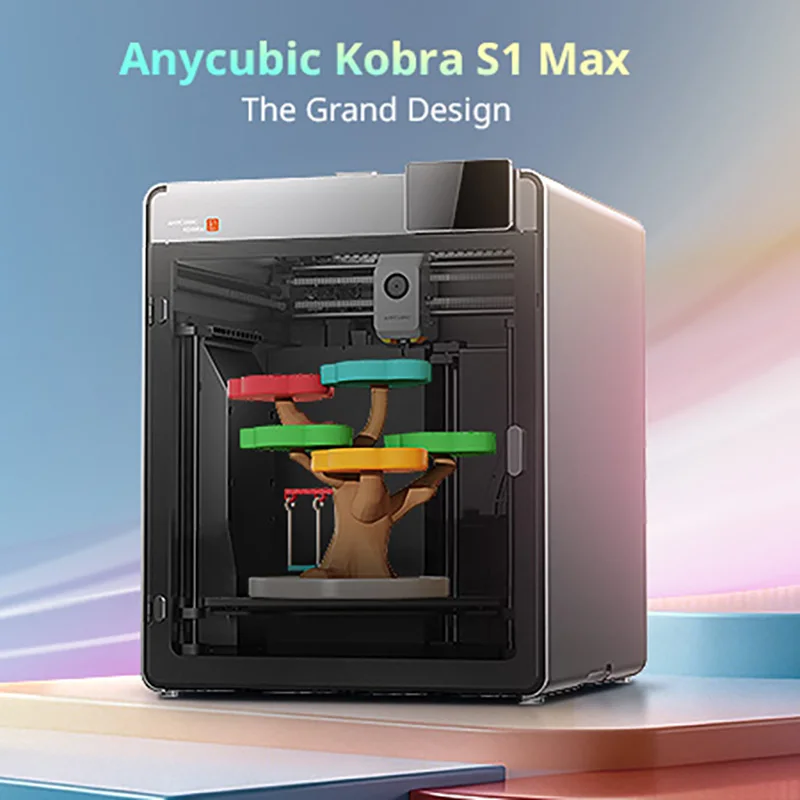
Discover why moisture ruins multi-color 3D prints. Learn how active filament drying on systems like the Anycubic Kobra 3 V2 Combo prevents stringing, brittleness, and feed failures.
Multi-color 3D printing has transitioned from an experimental novelty into an everyday creative powerhouse. With modern multi-material systems, creators and artists can produce intricate tabletop miniatures, functional multi-density prototypes, and vibrant decorative art in a single continuous print job.
However, jumping from standard single-extrusion to an 8-color multi-filament setup does more than double your creative palette—it exposes your filament to an unforgiving enemy: ambient moisture.
In single-color printing, a slightly damp spool might cause a few cosmetic blemishes or wispy strings you can quickly blast away with a heat gun. In an 8-color print running for 36 hours, that same moisture can cause catastrophic mid-tube snaps, color bleeding, jamming of the extruding tip , and failed prints.
In this deep dive, we explore the physics of how humidity degrades filament, why multi-color printing dramatically magnifies moisture problems, and how active drying systems—such as the Anycubic Color Engine Pro (ACE Pro) featured with the Anycubic Kobra 3 V2 Combo—deliver the reliable environment required for 8-color success.
1. The 8-Color Crucible: Why Multi-Color Prints Are Vulnerable
To understand why moisture is so destructive to multi-color printing, consider the mechanical demands of an 8-color print:
[Spool 1-8] ──> [PTFE Tubes] ──> [Filament Hub / Buffer] ──> [Extruding tip & Hot-end]
│
Frequent Retractions & Purges
(Hundreds to Thousands of Swaps)
- Extended Print Durations: An 8-color print requires hundreds or thousands of filament retractions, toolhead wipes, and purge-tower cycles. A model that prints in 4 hours in monochrome can easily stretch into a 24 to 48+ hour marathon. Over two days, exposed spools continuously pull moisture from ambient room air.
- Complex Feeding Paths: Eight spools feed through individual Bowden PTFE tubes into a multiplexer/feeder hub before reaching the print head. If any single filament becomes brittle, it risks snapping inside a Bowden tube or buffer mechanism, immediately halting the entire print.
- Heightened Retraction Frequency: Every color change demands a sequence: retracting the old filament, flushing the nozzle, wiping the tip, and feeding the new material. Damp filament responds unpredictably during rapid retractions, turning minor nozzle drool into severe cross-color contamination.
2. The Chemistry: How Moisture Destroys Filament
Most 3D printing thermoplastics are inherently hygroscopic—their molecular structure readily attracts and absorbs water molecules from atmospheric humidity.
| Filament Type | Hygroscopic Severity | Typical Time to Degradation in 50% RH | Primary Symptoms When Wet |
|---|---|---|---|
| PLA / PLA+ | Moderate | 24 – 72 Hours | Severe brittleness, snapping in PTFE tubes, nozzle popping |
| PETG | High | 12 – 24 Hours | Excessive stringing, cob-webbing, fuzzy surface finish |
| TPU (Flexible) | Very High | 4 – 8 Hours | Foaming, bubbling, loss of layer adhesion, severe clogging |
| PVA / BVOH (Support) | Extreme | 1 – 3 Hours | Becomes soft/gummy, jams the extruding gears and liquefies in feed path |
| ABS / ASA | Moderate | 24 – 48 Hours | Delamination, warping, structural voids |
A. The “Steam Explosion” Effect at the Hot-end
When filament enters the melt zone, temperatures range between 190°C and 260°C. Water boils at 100°C. As moist filament hits the heating block:
- Absorbed water molecules instantaneously flash into superheated steam, expanding roughly 1,600 times in volume.
- This rapid expansion produces distinct snapping and popping sounds at the nozzle tip.
- The expanding steam creates microscopic bubbles and voids inside the molten plastic strand. When extruded, these bubbles leave pitted exterior walls, inconsistent layer lines, and internal structural weakness.
Moist Filament (H₂O trapped in polymer)
│
(Enters Hot-end @ 210°C)
Water Flashes into Steam (Expands about 1600x)
│
┌────┴──────────────────────────┐
▼ ▼
Micro-Explosions & Popping Inconsistent Pressure & Ooze
(Surface Pits & Structural Voids) (Severe Stringing & Smearing)
B. Why Wet Filament Causes Unstoppable Stringing
Many 3D printer hobbyists assume stringing is purely a retraction distance or temperature calibration issue. With wet filament, retraction settings cannot compensate for moisture:
- The boiling water acts as a violent propellant, building uncontrollable internal back-pressure within the nozzle cavity.
- Even when the extruding tip retracts 2–4mm of filament, the boiling steam forces molten plastic out of the orifice.
- This constant nozzle drool deposits fine, web-like strings across empty travel moves. In an 8-color print, black or red strings dragged across a pristine white perimeter cause muddy, contaminated surfaces.
C. Hydrolysis and Room-Temperature Brittleness
PLA is particularly prone to hydrolytic degradation. When PLA absorbs moisture, water molecules infiltrate the polymer chains and trigger chain scission—breaking the long polymer chains into shorter fragments.
The result? The filament loses tensile flexibility and becomes glass-like. When fed through the bends and curves of multi-spool Bowden tubes, the brittle strand snaps under standard tension. Clearing a broken fragment deep inside an 8-way multiplexer mid-print is one of the most frustrating experiences in 3D printing.
3. Passive Dry Boxes vs. Active Thermal Drying
A common misconception is that a sealed plastic box filled with silica gel beads is sufficient for multi-day prints.
| Feature | Passive Dry Box (Desiccant Only) | Active Filament Drying (Chamber + Heat) |
|---|---|---|
| Mechanism | Absorbs superficial moisture from surrounding ambient air | Uses heat to break hydrogen bonds, driving internal moisture out of the polymer core |
| Can it dry wet spools? | No. Desiccant cannot extract water molecules already bonded inside the plastic | Yes. Drives moisture outward and vents it away |
| Performance during 40hr prints | Desiccant gradually saturates; relative humidity climbs steadily | Constant temperature and low RH maintained throughout the print cycle |
| Spool readiness | Spools must be pre-baked in a separate oven or dehydrator | Filament is actively conditioned right up to the extruder drive gears |
Desiccants only maintain dry air around an already dry spool. If a spool arrives from the factory with residual water from the manufacturing water-cooling bath (a very common occurrence), desiccant packs will never extract it. Only thermal energy can break the polar bonds holding water inside the polymer matrix.
4. How the Anycubic Kobra 3 V2 Combo Solves the Multi-Color Moisture Dilemma
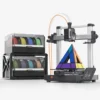
The Anycubic Kobra 3 V2 Combo addresses this challenge by integrating the Anycubic Color Engine Pro (ACE Pro) directly into the printing workflow.
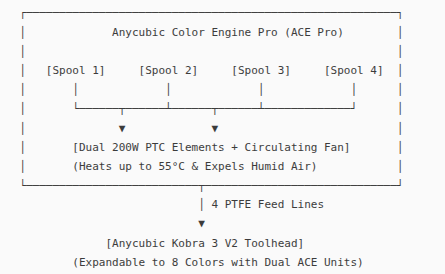
Instead of treating filament drying as a disconnected chore done hours before a print, the Kobra 3 ecosystem combines material management and climate control:
1. Dual 200W PTC Heating Elements with Air Circulation
Unlike passive enclosures or single-point heating plates that risk softening the bottom of your spools while leaving the top cold, the ACE Pro uses dual 200W PTC heating units paired with a circulating fan.
- It circulates warm air up to 55°C evenly across all spool bays.
- Air movement transfers heat uniformly across the entire diameter of each spool, liberating trapped moisture from outer and inner filament wraps alike.
2. Active “Dry While Printing” Architecture
The most critical feature for 8-color printing is the ability to dry while actively feeding filament.
- On a 36-hour multi-color project, the ACE Pro runs its heating cycle simultaneously with printing.
- Even if your workshop or basement sits at 65% relative humidity, the filament remains encased in a warm, low-humidity microclimate until the instant it enters the short PTFE lead to the extruder.
3. True 8-Color Scalability
By chaining two 4-slot ACE Pro units into a single Kobra 3 setup, makers unlock full 8-color printing across eight actively conditioned spools.
- Every material—whether you are combining contrasting PLA shades, tough PETG mechanical accents, or break-away support materials—maintains identical, moisture-free melt characteristics from layer 1 to layer 2,500.
4. Smart Clog & Tangle Management
Drying filament restores its natural elasticity, eliminating the brittleness that causes feed gear slippage. Paired with the Kobra 3’s intelligent buffer detection and automatic filament runout/tangle sensors, the printer avoids the false stops and jams common with damp materials.
5. Practical Checklist: Best Practices for Flawless 8-Color Prints
To achieve gallery-quality, defect-free multi-color prints, follow this pre-flight checklist:
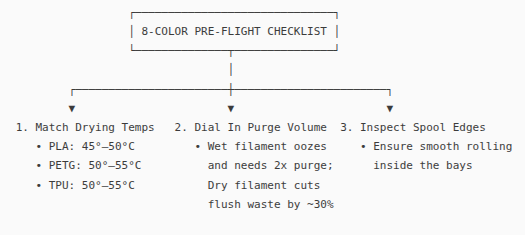
- Match Drying Cycles to Material Types:
- Standard PLA / Silk PLA: Run the ACE Pro at 45°C–50°C for 3–4 hours before starting, and leave active drying enabled during long runs.
- PETG & High-Speed PETG: Set drying to 50°C–55°C for at least 4–6 hours prior to high-detail prints.
- Flexible TPU (95A): Dry at 50°C–55°C for 6+ hours. Always print directly from an active chamber.
- Take Advantage of Reduced Purge Volumes:
- Wet filament oozes uncontrollably, forcing slicers to use excessively large purge blocks to clear color bleed.
- By keeping filament completely dry, color transitions sharpen significantly. You can safely dial down your purge volume multipliers in your slicer, saving up to 30% on purge tower filament waste over long runs.
- Verify Spool Edges & Buffer Tension:
- Cardboard spools can shed dust or deform if exposed to moisture over time. In a multi-spool enclosure, use spool edge adapter rings if needed to ensure smooth, low-friction rolling under the feeder motors.
Summary: Consistency Is the Secret to Multi-Color Success
In 8-color 3D printing, your margin for error is divided by eight. A single compromised spool out of eight can cause an extrusion failure 30 hours into a 32-hour print, ruining the entire piece and wasting hundreds of grams of filament.
Active filament drying eliminates the biggest variable in FDM 3D printing: inconsistent atmospheric humidity. With integrated drying solutions like the Anycubic Kobra 3 V2 Combo and its dual-PTFE ACE Pro system, you stop fighting stringing, popping, and mid-tube snaps—and start enjoying crisp, vibrant, professional multi-color prints every time.
Ready to Upgrade Your Multi-Color Printing Experience?
Explore the Anycubic Kobra 3 V2 Combo, high-performance dry-box accessories, and premium filaments at Tinkerlab Store—your dedicated lab for creating, printing, and connecting.
7:10 PM